WhatsApp as a Sales Channel: A Playbook for Mid-Market Brands

Mid-market brands are great at building products. Building the infrastructure to sell them at scale is a different skill entirely. Many still rely on email sequences that open 20% of the time, paid ads with declining returns, and a retargeting stack that costs more every quarter to deliver the same results. The channel mix is getting harder to justify, and the numbers show it.
Meanwhile, the channel that most mid-market brands have either ignored or underinvested in is quietly becoming the highest-converting customer touchpoint in the world. Think of WhatsApp as the shop floor assistant who greets every customer by name, knows what they bought last time, and answers before they even finish typing their question. That is not a future state. It is what mid-market brands in Brazil, Germany, the Middle East, and increasingly the US and UK are already running.
This playbook is for teams who are past asking 'should we do WhatsApp?' and are ready to answer 'how do we do it properly?' It covers the infrastructure, the tactics, the compliance rules that determine whether your account thrives or gets suspended, and the specific plays that convert conversation into revenue.
Boost Your Business
In This Guide
- Why WhatsApp Has Become a Primary Sales Channel in 2026
- What Is Holding Mid-Market Brands Back: Key Challenges
- What Your Customers Are Already Doing on WhatsApp
- The WhatsApp Sales Playbook: Six Channels and Tactics
- Real-Life Case Study: How Unilever Turned Billboards Into Conversations
- Final Thoughts
So, Why Has WhatsApp Become a Primary Sales Channel in 2026?
WhatsApp is not a messaging app with some business features bolted on. It is the world's largest customer communication platform, and the numbers behind that statement are no longer debatable.
Having a WhatsApp sales channel matters for mid-market brands right now because:
- WhatsApp reached 3.3 billion monthly active users in early 2026, with users checking the app 20 to 25 times per day and spending an average of 35 to 38 minutes on the platform daily (DataReportal, 2026).
- WhatsApp messages achieve open rates of 95 to 98%, compared to 20 to 25% for email and approximately 90% for SMS, but with significantly higher engagement depth (WizMessage, 2026).
- WhatsApp delivers 2 to 3 times higher conversion rates than email for equivalent promotional offers (Flowcart, cited in eGrow, 2026).
- The global WhatsApp commerce market reached $45 billion in sales in 2026, growing 60% year-over-year from click-to-WhatsApp advertising alone (Invent, 2026).
- 175 million people message a WhatsApp Business account every single day, and 200 million businesses now actively use WhatsApp Business products globally (WizMessage, 2026).
The businesses winning on WhatsApp in 2026 are not the ones spending the most. They are the ones who understood earliest that WhatsApp is not a broadcast channel. It is a conversation channel. The playbook is fundamentally different from email, and most mid-market brands are still writing the wrong one.
Read our guide on Conversational Commerce Strategy for Growing Brands to understand how WhatsApp fits into a full-funnel revenue architecture.
Why the WhatsApp Opportunity Is Still Underused: Key Challenges for Mid-Market Brands
Mid-market brands occupy an awkward middle ground on WhatsApp. Enterprise brands have the technical teams to build custom integrations. Small businesses have the agility to experiment without consequence. Mid-market brands, typically between $5 million and $150 million in annual revenue, face a specific set of structural challenges that keep them from activating WhatsApp at the scale the platform rewards.
| Challenge | Problem | How to Do It Right |
|---|---|---|
| Compliance feels like a blocker | Meta's opt-in requirements are strict and non-negotiable. Many mid-market teams assume their existing email or SMS lists can be migrated over. They cannot. Trying to bypass this leads to account suspension, not a slap on the wrist. | Build consent collection into every customer touchpoint from day one: checkout forms, post-purchase pages, in-store QR codes. The channel is only as valuable as the opted-in list behind it. |
| Tech stack integration is underestimated | Connecting WhatsApp Business API to a CRM, e-commerce platform, and analytics stack sounds like a two-week project. For mid-market teams without dedicated engineering resources, it regularly becomes a two-month one. | Start with a WhatsApp Business Solution Provider (BSP) that handles the technical layer. Prioritise CRM integration above all else; the channel's personalisation advantage evaporates without it. |
| Template approval slows momentum | Every business-initiated message outside the 24-hour service window requires a pre-approved template. Teams used to email's creative freedom get frustrated with the approval cycle and either abandon campaigns or push out non-compliant messages that tank their quality rating. | Treat template creation like compliance, not copywriting. Build a library of 15 to 20 pre-approved templates covering every stage of the customer lifecycle, so campaigns can launch without waiting. |
| Measurement gaps create doubt | WhatsApp has historically felt like a black box compared to email or paid ads. Without proper tracking, marketing and commercial teams cannot prove ROI to leadership, and budgets stall at the pilot stage. | Implement UTM parameters on every link, track conversation-to-purchase rates inside your BSP, and connect WhatsApp-sourced revenue back to your CRM attribution model before scaling spend. |
If your mid-market brand is ready to build a WhatsApp sales infrastructure that is compliant, connected, and conversion-ready, XCCELER's brand strategy team can help you design the system before you build it.
What Your Customers Are Already Doing on WhatsApp
The best WhatsApp strategies are built on a simple insight: your customers are already on the platform, already using it to communicate with brands they trust, and already expecting it from brands they are considering.
Understanding what your customers are doing on WhatsApp before you message them changes how you design the entire channel.
- They are using it as a search engine for local and personal purchases. 68% of users say WhatsApp is the most convenient way to contact brands (Jesty CRM, 2026). For mid-market brands in physical goods, services, or anything with a post-purchase support need, WhatsApp is where customers go when they want a human response at digital speed.
- They are browsing product catalogs and making decisions inside the app. WhatsApp business catalogs attract over 40 million users browsing products every month (Meta, 2026). For fashion, beauty, food, and home goods brands, product discovery is already happening on WhatsApp, whether or not you are present for it.
- They respond faster on WhatsApp than on any other channel. The average response time to a WhatsApp message is 45 to 90 seconds, compared to 6 or more hours for email (WizMessage, 2026). When your customer is in the decision window, WhatsApp is the only channel fast enough to stay in it with them.
- They judge brand credibility by the WhatsApp experience. 64% of users say messaging a brand on WhatsApp builds a stronger personal connection than other channels (Jesty CRM, 2026). A slow or robotic WhatsApp experience does not just fail to convert; it actively damages brand perception.
The WhatsApp Sales Playbook: Six Channels and Tactics
Click-to-WhatsApp Ads (CTWA)
Click-to-WhatsApp Ads are Meta ads on Facebook or Instagram where the CTA button opens a WhatsApp conversation instead of redirecting to a landing page or website. The user clicks the ad, a WhatsApp chat opens, and the conversation begins.
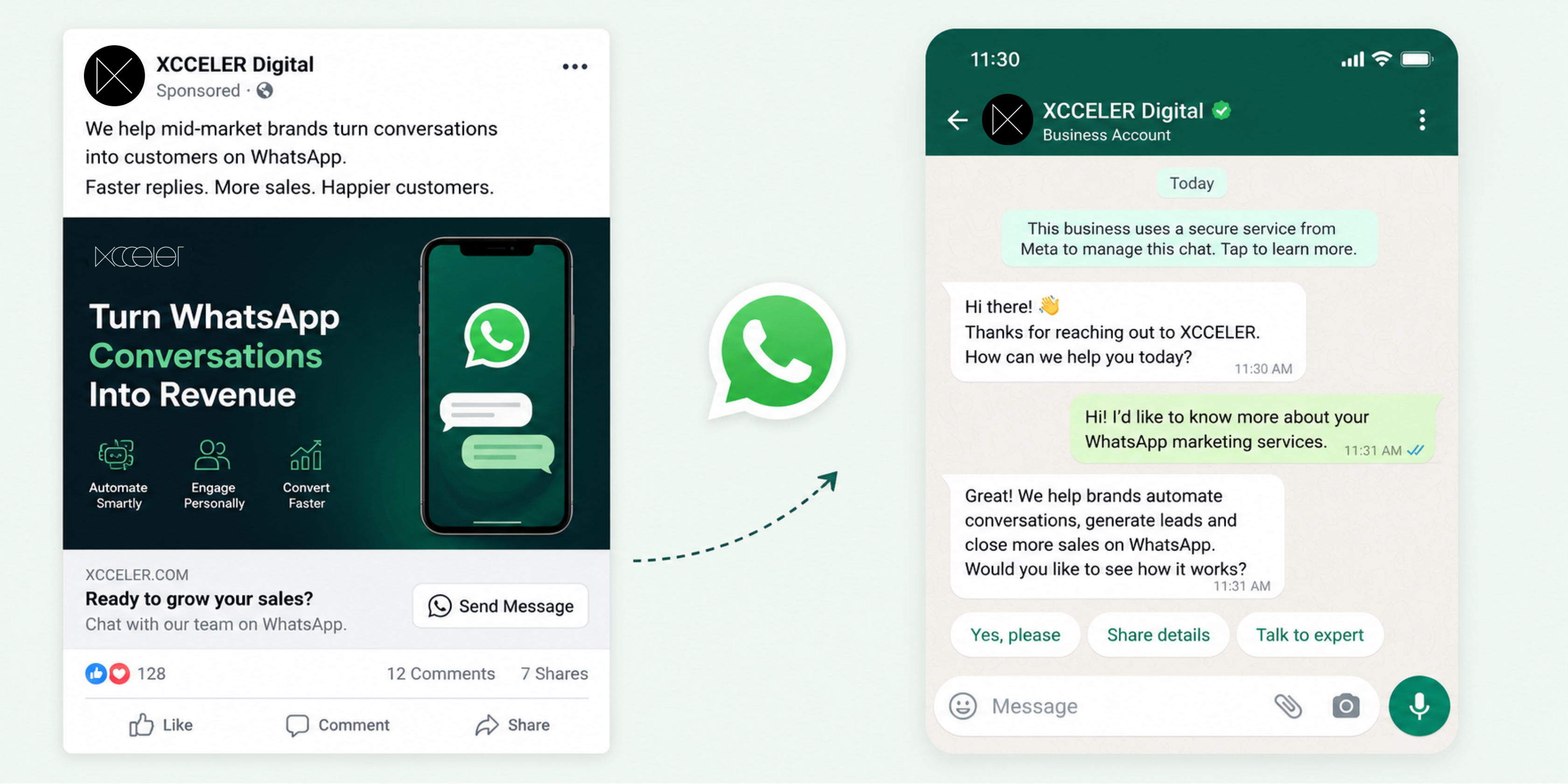
How it works in real life:
- A user sees your ad in their Facebook or Instagram feed for a product they have been researching.
- Instead of clicking through to a landing page they may or may not engage with, they tap 'Send Message.'
- A WhatsApp chat opens with a pre-populated greeting from your brand.
- An automated flow qualifies the lead, answers questions, and either converts directly or routes to a human sales agent.
Business result: Business result: Click-to-WhatsApp advertising revenue is growing at 80% year-over-year and is now Meta's fastest-growing ad format, generating approximately $10 billion annually (Chatarmin, 2026).
Read our guide on Meta Ad Strategy for Mid-Market Brands to understand how to integrate CTWA into your existing paid social framework.
WhatsApp Broadcast Campaigns
A WhatsApp broadcast is a message sent from your business number to a list of opted-in contacts simultaneously. Each recipient receives it as an individual message, not a group chat. It is the closest WhatsApp equivalent to an email newsletter, but with fundamentally different engagement dynamics.
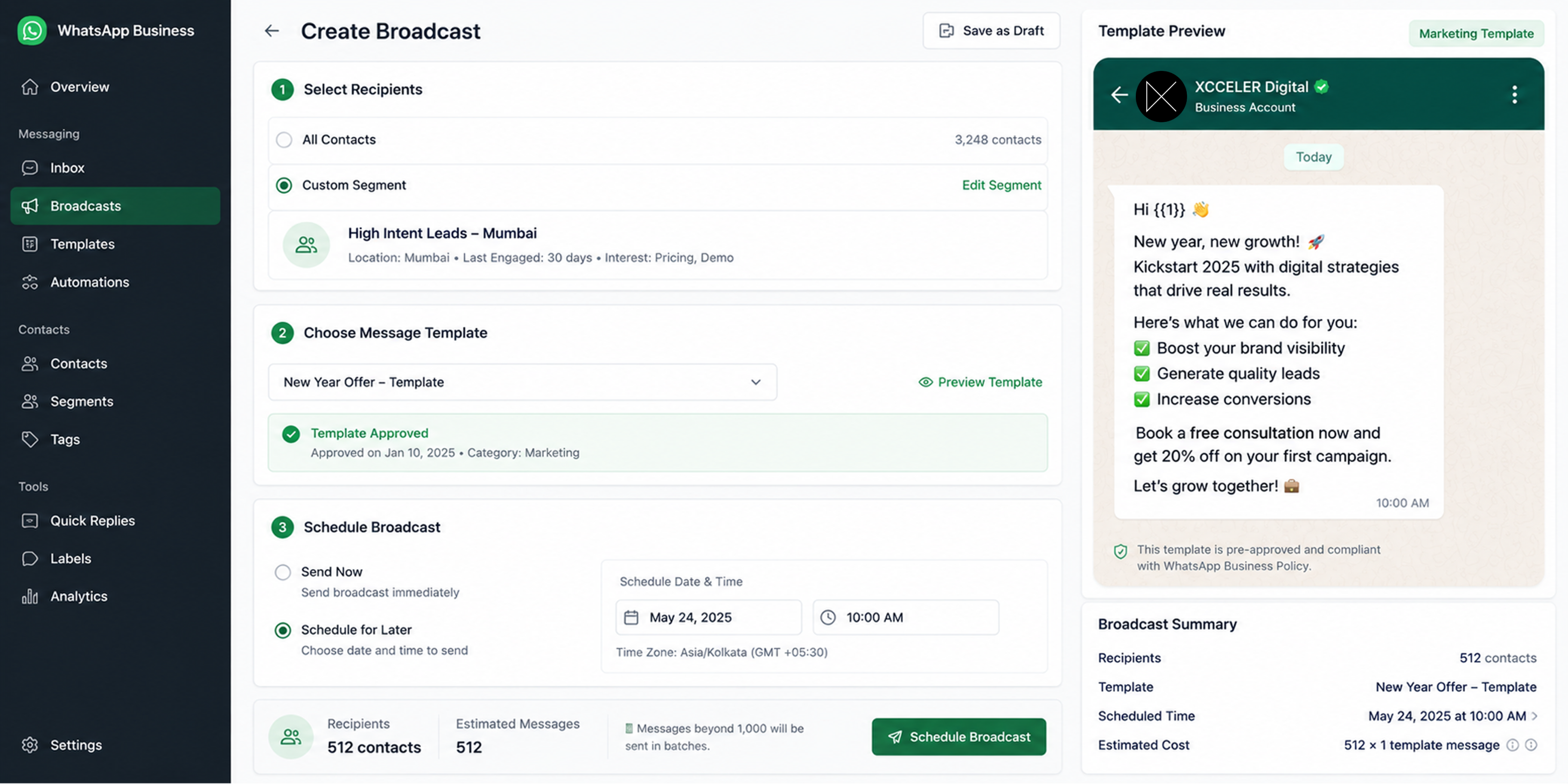
How it works in real life:
- Your BSP pulls a segmented list from your CRM: customers who purchased in the last 90 days but have not returned.
- A pre-approved re-engagement template is selected and personalised with the customer's name and last purchase category.
- The broadcast is scheduled and sent within Meta's messaging policy guidelines.
- Customers who respond enter a 24-hour free-form conversation window; those who click through to purchase are tracked against the broadcast send.
Business result: Business result: WhatsApp broadcast campaigns achieve a 5 to 15% CTR, which is 2 to 3 times higher than equivalent email campaigns, with an $8 to $15 revenue-per-conversation benchmark for mid-market brands (eGrow, 2026).
WhatsApp Flows (Interactive In-Chat Forms)
WhatsApp Flows are interactive forms and structured experiences that live entirely inside a WhatsApp chat. Users complete multi-step processes such as placing an order, booking an appointment, filling out a consultation form, or configuring a product without ever leaving the app.
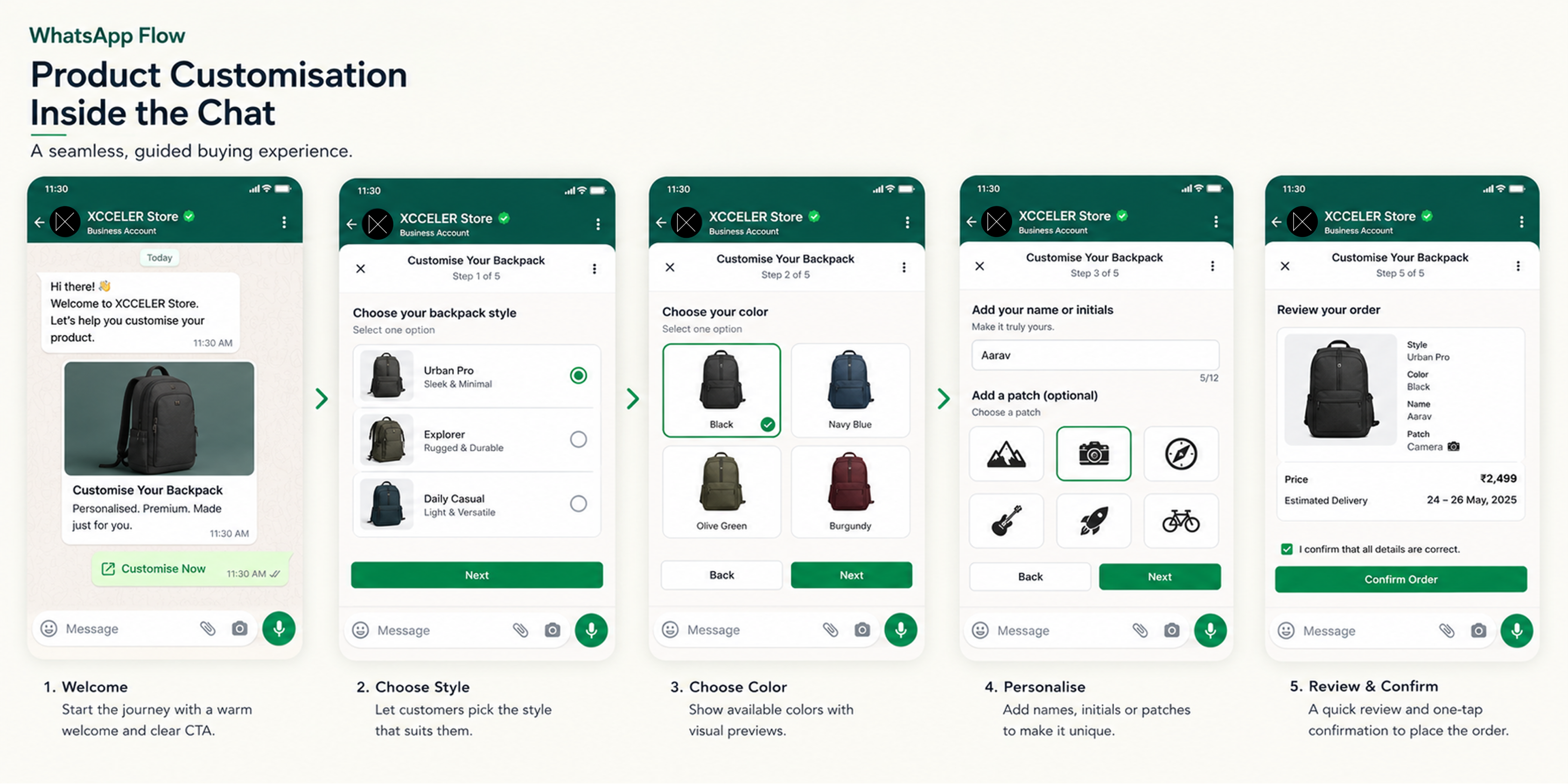
How it works in real life:
- A customer receives a WhatsApp message inviting them to book a product consultation or configure a custom order.
- They tap the CTA inside the message, and a structured form opens within the chat interface.
- They complete the flow in 60 to 90 seconds: selecting options, entering details, confirming.
- The submission triggers an automated confirmation message and syncs to your CRM or order management system.
Business result: Business result: Businesses combining WhatsApp Catalog and Flows see an average order value of $47, compared to $32 via their mobile website, with a catalog-to-purchase conversion rate of 18% (Meta Commerce Report, cited in Searchlab, 2026).
Our guide on Conversion Rate Optimisation for Mobile-First Brands covers how WhatsApp Flows compare to traditional checkout flows in reducing abandonment.
WhatsApp Chatbots for Lead Qualification
A WhatsApp chatbot is an automated conversation flow that handles inbound messages, qualifies leads, answers frequently asked questions, and routes high-intent prospects to a human sales agent. Done well, it acts as a 24/7 sales development representative that never misses a message.
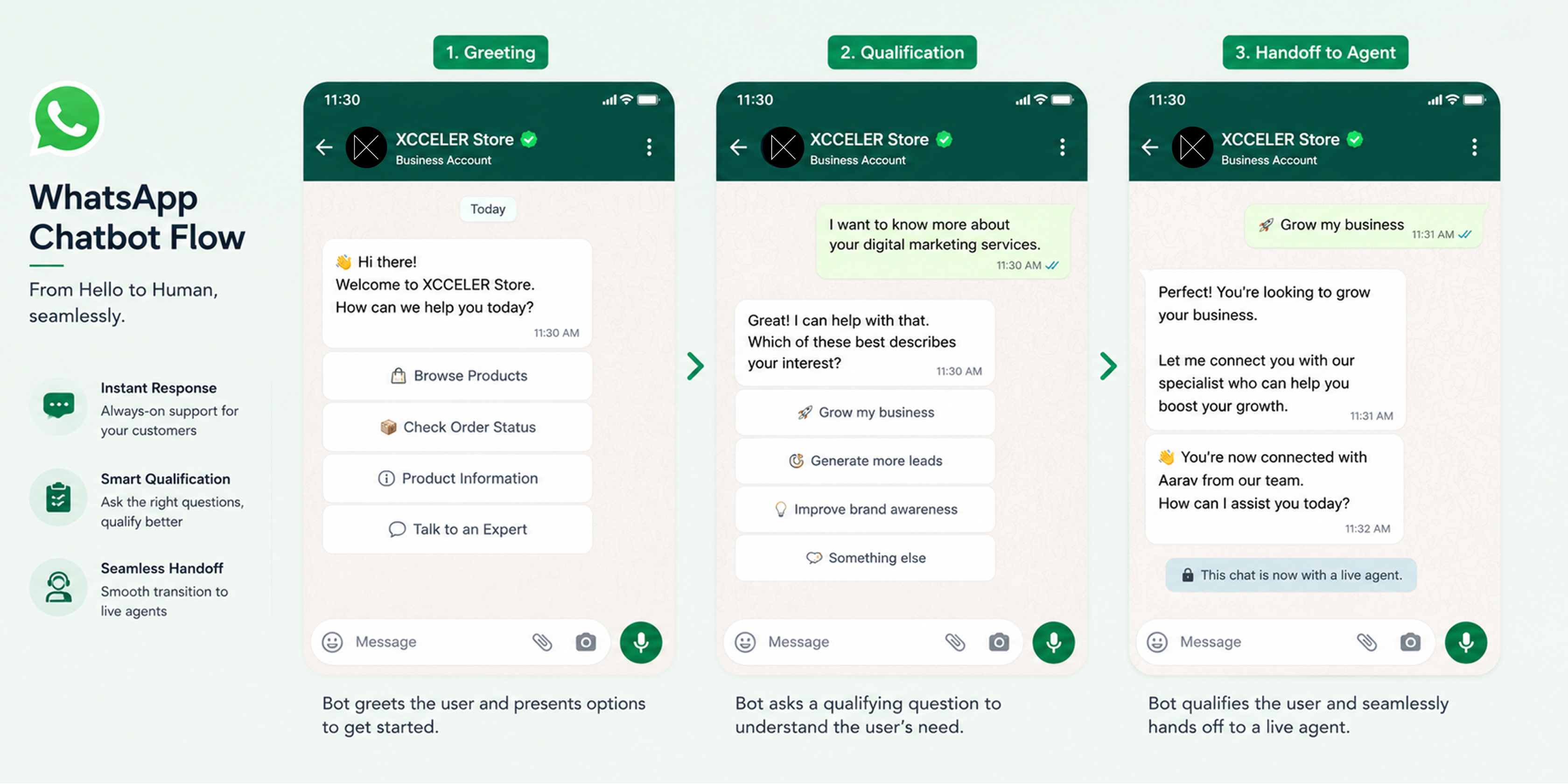
How it works in real life:
- A customer messages your WhatsApp number after seeing a product on Instagram.
- The chatbot greets them, identifies their product interest from their message, and asks two or three qualifying questions.
- Based on their responses, it either answers directly with product information and a purchase link, or flags the conversation as high intent and routes to a human agent with a summary of the lead.
- The human agent picks up a qualified, context-rich conversation rather than a cold inbound message.
Business result: Business result: WhatsApp chatbots generate up to 5 times more leads than traditional marketing channels, with an average lead conversion rate of 28% for chatbot-qualified prospects (Jesty CRM, 2026).
| Action | Do | Don't |
|---|---|---|
| Chatbot handoff to human | Set a clear handoff trigger: 'Let me connect you with a specialist' when intent is high | Keep the customer in a chatbot loop when they have asked to speak to a human |
| Bot personality | Give the bot a name and a consistent tone that matches your brand voice | Use generic, corporate language that signals 'this is a script' |
| Response after handoff | Acknowledge the handoff with an expected wait time | Go silent after routing; dead air breaks trust faster than a slow response |
WhatsApp for Post-Purchase Experience
The post-purchase journey is where most mid-market brands abandon the WhatsApp opportunity. Order confirmation goes to email. Shipping updates go to SMS. Returns are handled by a web form. Each touchpoint moves the customer away from a channel they were already in.
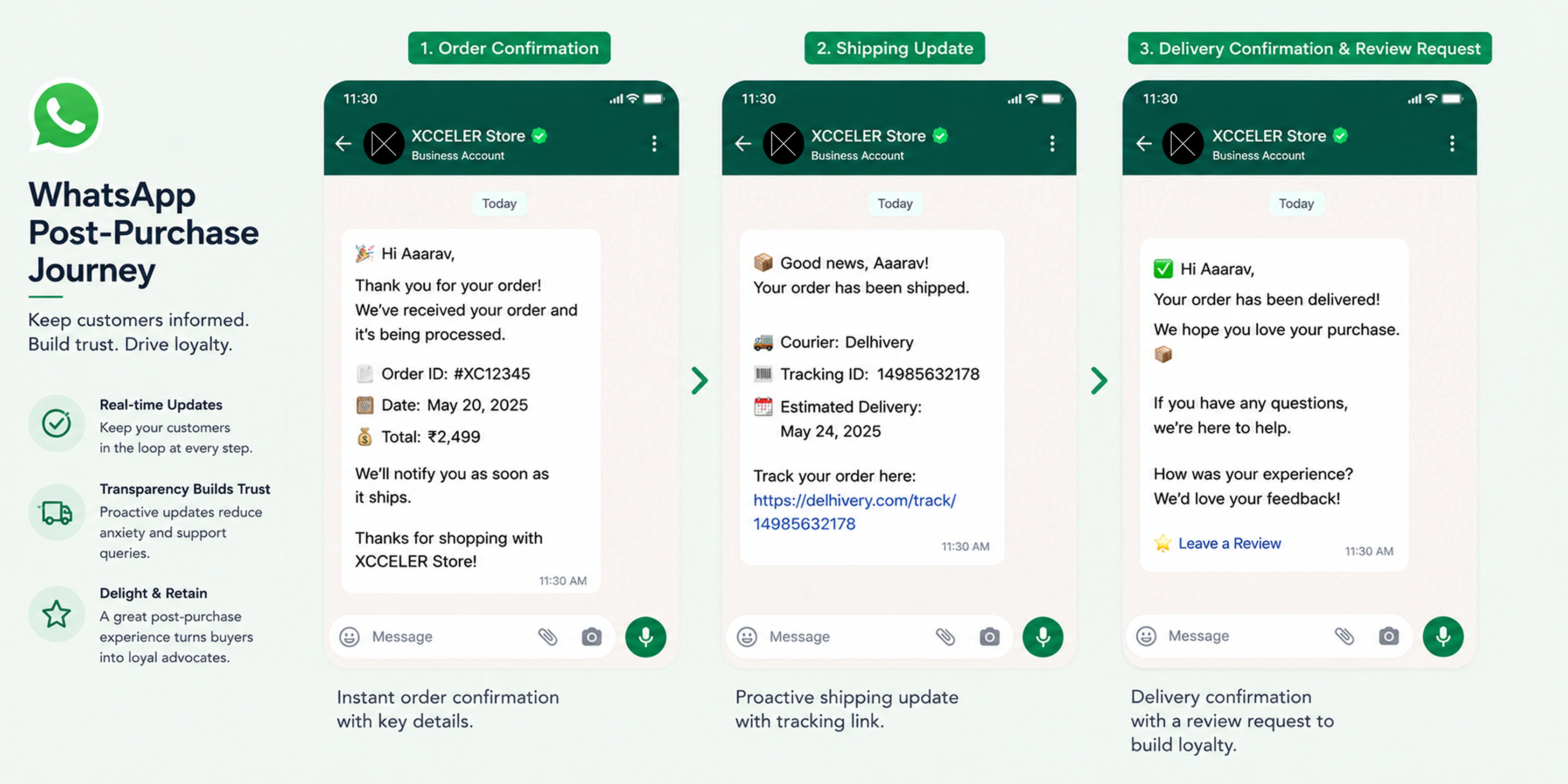
How it works in real life:
- Customer completes a purchase on your website.
- An automated WhatsApp message confirms the order within 60 seconds, with an order summary and a link to track their purchase.
- A second message triggers when the order ships, with a live tracking link embedded in the chat.
- A third message on delivery invites the customer to share a review or raise any issue, opening a 24-hour service window.
Business result: Business result: WhatsApp order confirmation messages achieve a 45% engagement rate compared to 15% for equivalent email confirmations, with significantly higher customer satisfaction scores on post-purchase communication (DPDPA, 2025).
WhatsApp Retention and Win-Back Sequences
WhatsApp's opt-in nature makes it one of the most effective channels for retention and reactivation, precisely because every contact on your list has already signalled they want to hear from you. The challenge is sending messages that feel worth reading, not promotional spam.
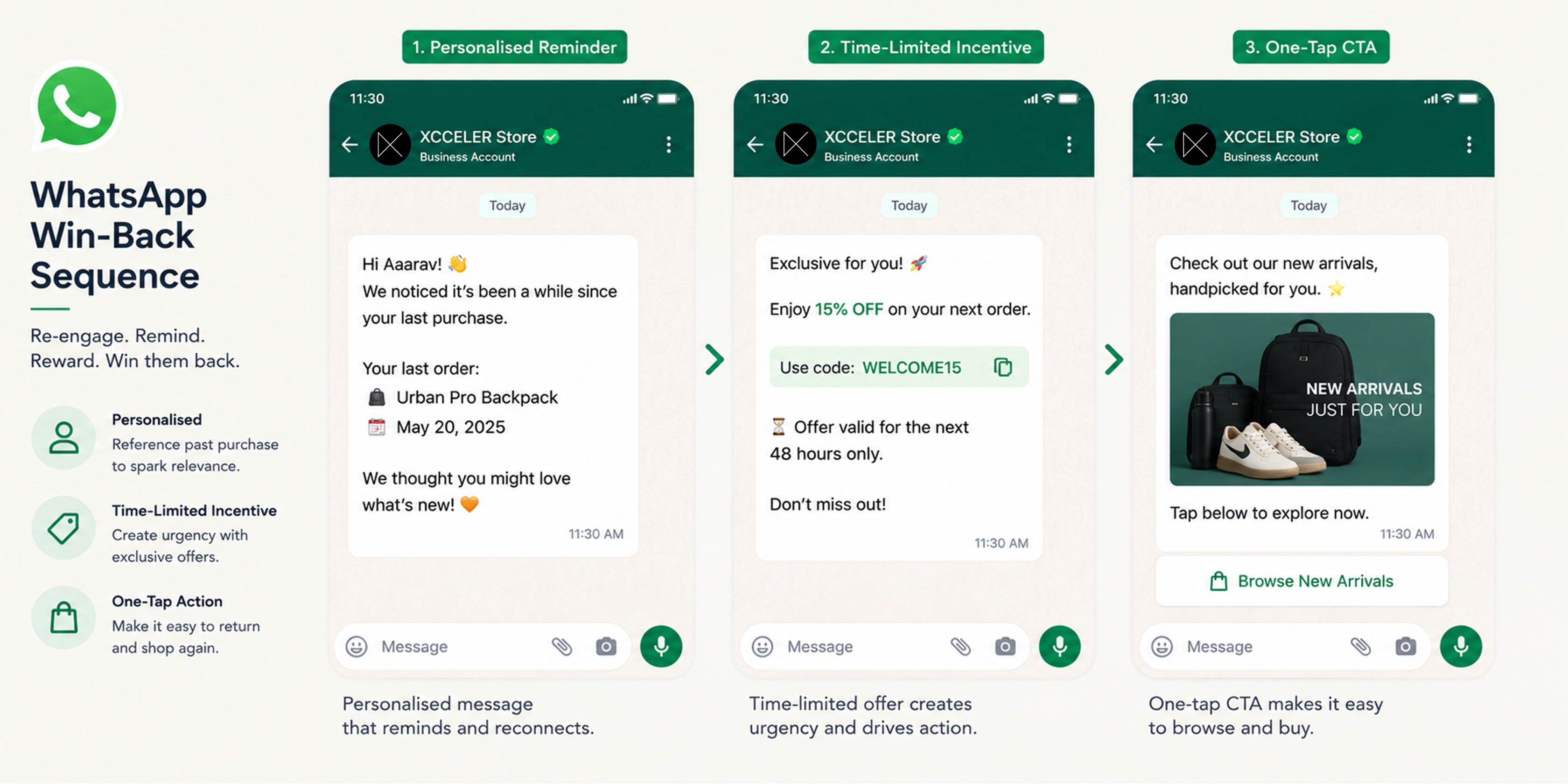
How it works in real life:
- Your CRM identifies customers who last purchased 90 to 120 days ago and have not responded to two email re-engagement attempts.
- A WhatsApp win-back template is triggered: personalised with their name, last product category, and a relevant new arrival or offer.
- Customers who engage enter a free-form conversation window; those who do not are added to a re-consent sequence before any further WhatsApp contact.
- Conversion data from the campaign feeds back into your segmentation model, adjusting future send frequency and content for each cohort.
Business result: Business result: WhatsApp-driven engagement produces a 27% sales increase for businesses using the channel as part of a structured retention programme (Jesty CRM, 2026).
Read our piece on Customer Retention Strategy for Mid-Market Brands to understand how WhatsApp sits within a broader retention architecture.
| Action | Do | Don't |
|---|---|---|
| Personalisation | Reference the customer's last purchase category or specific product | Send a generic 'We miss you!' message with no product context |
| Incentive structure | Time-limit the offer (48 hours) to create real urgency | Run the same discount indefinitely; it trains customers to wait |
| Re-consent management | Honour optouts immediately and remove from all send lists | Continue sending to contacts who have not responded in 6 months without a re-consent check |
WhatsApp Sales Channel: Tactics at a Glance
| Tactic | Effort Required | Time to Impact | Best For |
|---|---|---|---|
| Click-to-WhatsApp Ads | Medium | 1 to 2 weeks | Brands already running paid social; fastest entry point to WhatsApp leads |
| Broadcast Campaigns | Low to medium | 2 to 4 weeks | Brands with an existing opted-in customer base; highest immediate revenue impact |
| WhatsApp Flows | Medium to high | 4 to 8 weeks | Brands with complex purchase journeys; reduces checkout abandonment |
| Chatbot Lead Qualification | Medium to high | 4 to 8 weeks | Brands with high inbound inquiry volume; scales sales capacity without headcount |
| Post-Purchase Sequences | Low | 1 to 2 weeks | All brands; highest-impact, lowest-complexity starting point |
| Retention and Win-Back | Medium | 2 to 4 weeks | Brands with dormant customer segments; measurable ROI against a defined cohort |
Real-Life Case Study: How Unilever Turned Billboards Into Conversations
Unilever needed to launch Comfort, a new fabric softener, in Brazil without the budget for a conventional product launch. Rather than running TV spots or digital display campaigns into a passive audience, the team built the entire customer journey into WhatsApp.
They placed over 10,000 billboards across Sao Paulo with a teaser message and a WhatsApp number. No website URL. No QR code to a landing page. The number was the entire call to action.
When customers messaged the number, a chatbot called MadameBot took over. It gave personalised fabric care tips, introduced the product through rich media including audio and video clips, and offered a 50% discount with free shipping to customers who completed the conversation flow.
Here is how the strategy was structured:
| Channel | Approaches Used |
|---|---|
| Offline-to-WhatsApp entry | 10,000 OOH placements across Sao Paulo; WhatsApp number as the sole CTA; curiosity-driven teaser copy drove inbound messages |
| Chatbot engagement | MadameBot delivered fabric care education before any product mention; introduced Comfort as a natural solution to problems customers had just described |
| Conversion mechanics | Rich media demonstration of product benefits inside chat; 50% discount plus free shipping offered to customers who completed the flow |
| Outcome tracking | Campaign engagement tracked through conversation volume, completion rate, and promotional code redemption |
The Results
- 290,000 messages exchanged over 7 days with 12,000 unique customers (Zoko, 2026)
- 138% increase in sales during the campaign period (Infobip, 2025)
- Product education embedded into the purchase journey reduced the need for returns or post-purchase complaints
What made this work was not the chatbot. It was the sequencing. Unilever educated before they sold. The discount felt earned, not pushed. And the conversation happened where the customer was already spending time, not on a landing page they would have closed in 4 seconds.
If your mid-market brand is ready to build a WhatsApp sales infrastructure that converts the way Unilever's campaign did, [XCCELER's brand strategy team] can help you design the architecture before you build it.
The Compliance Architecture Every Mid-Market Brand Needs First
Before any of the tactics above can work at scale, the compliance foundation has to be in place. This is not optional, and it is not separable from the sales strategy. Meta's quality rating system means that non-compliant behaviour directly limits how many people you can message per day. Enough complaints and your account is suspended, with no appeal process for the channel you built.
The non-negotiables for mid-market brands in 2026:
- Explicit, channel-specific opt-in: General marketing consent does not cover WhatsApp. Customers must actively consent to receive messages specifically on WhatsApp, with your business name clearly stated at the point of opt-in. Pre-checked boxes do not qualify.
- Template pre-approval: All business-initiated messages outside the 24-hour service window must use a Meta-approved template. Build a library before you need it, not during a campaign.
- Quality rating management: Meta assigns every WhatsApp Business number a quality rating (Green, Yellow, or Red) based on user complaints, block rates, and engagement. High-quality senders get higher daily message limits. Red-rated accounts see limits slashed and risk suspension.
- 24-hour service window: When a customer messages you first, you have 24 hours to respond with any message type, no template required. This window is your highest-converting opportunity; the response time within it is everything.
- Regional compliance layering: WhatsApp consent rules apply globally, but local regulations layer on top. GDPR in Europe, LGPD in Brazil, and DPDP in India each have additional requirements around data storage, consent records, and opt-out honouring (AuditSocials, 2026).
Final Thoughts
WhatsApp is not a channel you add to the stack. It is a channel that reorganises how the stack works.
For mid-market brands, the opportunity is real and the window to capture it before competition saturates the space is narrowing. The brands building WhatsApp infrastructure now, with compliant opt-in flows, connected CRMs, pre-approved template libraries, and defined conversation playbooks, are the ones who will have the cost and conversion advantage when the channel becomes as crowded as email.
The playbook is not complicated. Start with post-purchase sequences because the infrastructure is already there and the customer is already in a high-trust moment. Add broadcasts to your opted-in list. Layer in CTWA ads to grow that list from paid channels. Then build toward Flows and chatbots as your team's confidence and data model mature.
Your customers are already on WhatsApp. The question is whether you are there when they are.
If your mid-market brand is ready to build WhatsApp into a primary sales channel and wants a strategic framework before committing to the infrastructure, this is exactly the kind of work XCCELER does. We help growing brands design the conversation architecture, compliance foundation, and channel integration strategy before a single message is sent.
About XCCELER
XCCELER is a growth acceleration and brand strategy firm that partners with mid-market brands to design strategies and experiences that convert interest into revenue. Our work spans brand positioning, channel strategy, and conversion architecture, built around the changes that move commercial metrics without requiring a full organisational overhaul.
Learn how XCCELER works with mid-market brands