Why Your Brand Identity Is Losing You Leads Before Your Ads Even Run
Your marketing may not be the reason your leads aren't converting. Your brand identity might be.

Many businesses believe branding is something you finish before launching the website, printing business cards or running your first campaign. Once the logo is approved and the colour palette is chosen, branding is considered done.
Imagine walking into two cafés on the same street. Both serve equally good coffee. One has a clean storefront, consistent menus, friendly signage and staff who all communicate the same experience. The other has three different logos, outdated posters, mismatched interiors and a menu designed ten years ago. Even before tasting the coffee, you've already decided which business feels more trustworthy.
That is exactly how prospects judge your business online.
Every advertisement, referral, LinkedIn profile, landing page and proposal contributes to a single question in your customer's mind: "Does this business feel credible enough to trust?" When the answer is uncertain, marketing becomes dramatically more expensive. Ads cost more to convert. Referral leads hesitate. Sales conversations take longer. Prices become harder to defend. The solution isn't simply creating a better logo. It's treating brand identity design as a commercial growth system rather than a one-time creative project. Here are the four identity gaps that quietly reduce lead generation before your advertising has a chance to work.
Boost Your Business
Why the Problem Stays Hidden
Most businesses blame weak lead generation on marketing channels. They increase advertising budgets, experiment with different targeting, hire another agency or redesign landing pages. Very few step back to ask whether the brand people arrive at is creating confidence—or doubt. That's because traditional marketing metrics only measure what happens after someone clicks. They don't measure how many potential customers chose not to click because the business looked inconsistent. They don't measure referrals who hesitated after checking the website. They don't measure prospects who compared two companies and selected the one that simply felt more established. Research consistently shows that first impressions happen in milliseconds, and visual consistency plays a significant role in perceived trust and credibility. Studies from the University of Missouri suggest users form impressions of a website in less than two-tenths of a second, while consistent brand presentation has been associated with stronger recognition and customer trust across multiple touchpoints. The commercial impact compounds. A prospect who already trusts your brand arrives warmer, converts faster and requires less persuasion. A prospect who feels uncertain demands more proof, more meetings, more discounts and more reassurance before making the same decision. Marketing teams often focus on reducing cost per click. The better question is whether your identity is reducing the cost of earning trust. If your business hasn't reviewed its identity system in the past three to five years, it may already be reducing the effectiveness of every campaign you run.
Four Brand Identity Problems That Lose Leads Before Marketing Begins
Your Brand Looks Different Everywhere Customers Meet You
The most common branding mistake isn't having an unattractive logo. It's having several different versions of the same business. A customer clicks your Google ad and lands on a modern website. They visit LinkedIn and find outdated banners. They receive a proposal using different colours. Your Instagram posts follow another design style altogether. Individually, none of these differences seem significant. Collectively, they create doubt.
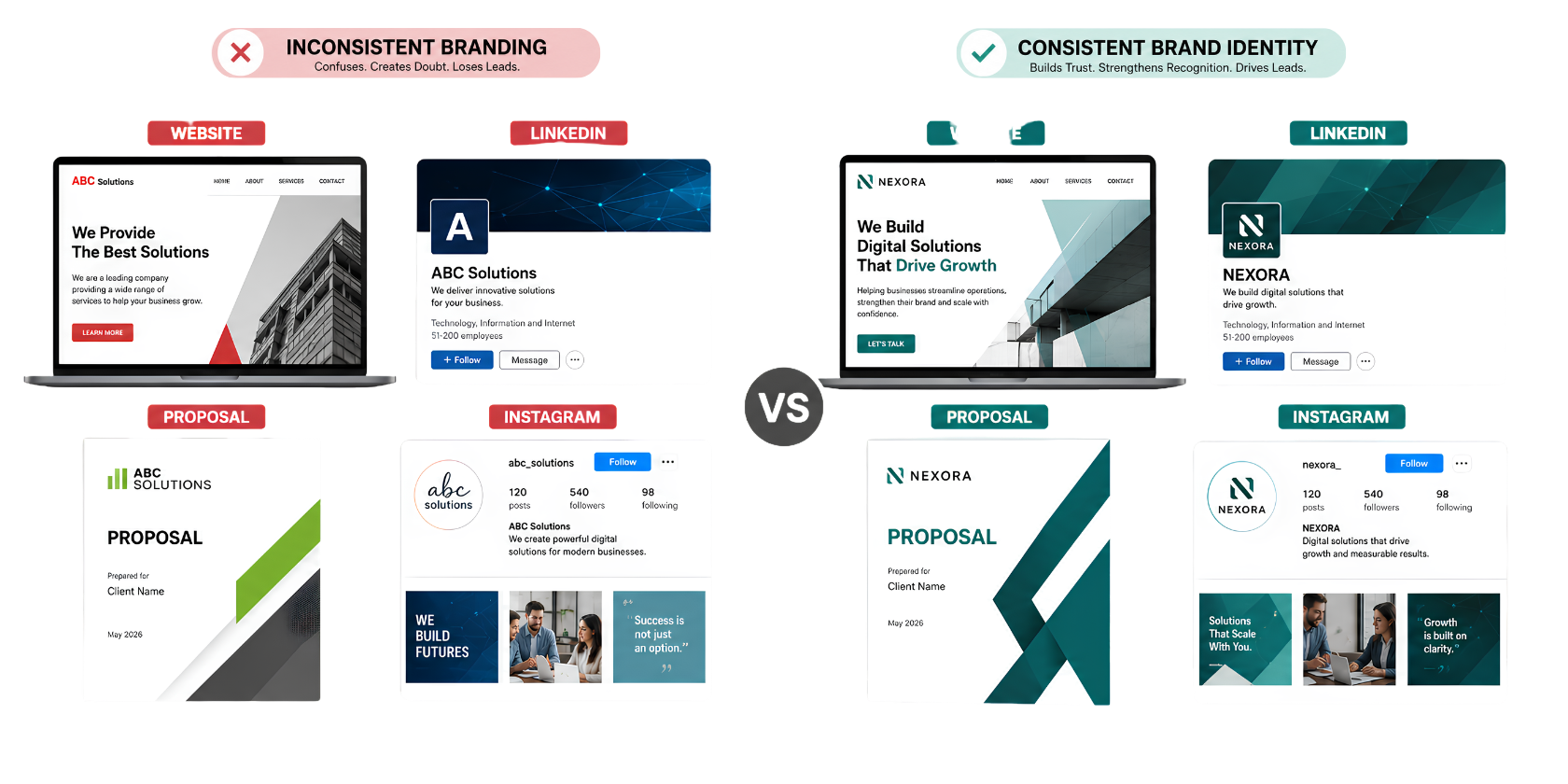
Customers rarely describe this as "poor branding." Instead they say things like: "Something felt off." "They didn't look established." "The other company seemed more professional." Trust isn't built through a logo. It's built through repetition. Every consistent interaction reinforces credibility. Every inconsistency introduces uncertainty.
| Action | Do | Don't |
|---|---|---|
| Logo usage | Maintain one approved logo system across every platform | Use outdated logo versions depending on the platform |
| Colours & typography | Apply consistent brand colours and fonts everywhere | Let every designer choose different styles |
| Brand assets | Maintain a central brand guideline for all teams | Create new assets independently for every campaign |
Your Brand Talks About You Instead of Your Customer
Many businesses spend months perfecting their brand identity, only to fill it with messages their customers don't actually care about. The homepage talks about when the company was founded. The About page lists awards and certifications. Social media celebrates office milestones. Every piece of communication answers the question, "Who are we?" Meanwhile, your customer is asking something completely different: "Can you solve my problem?"
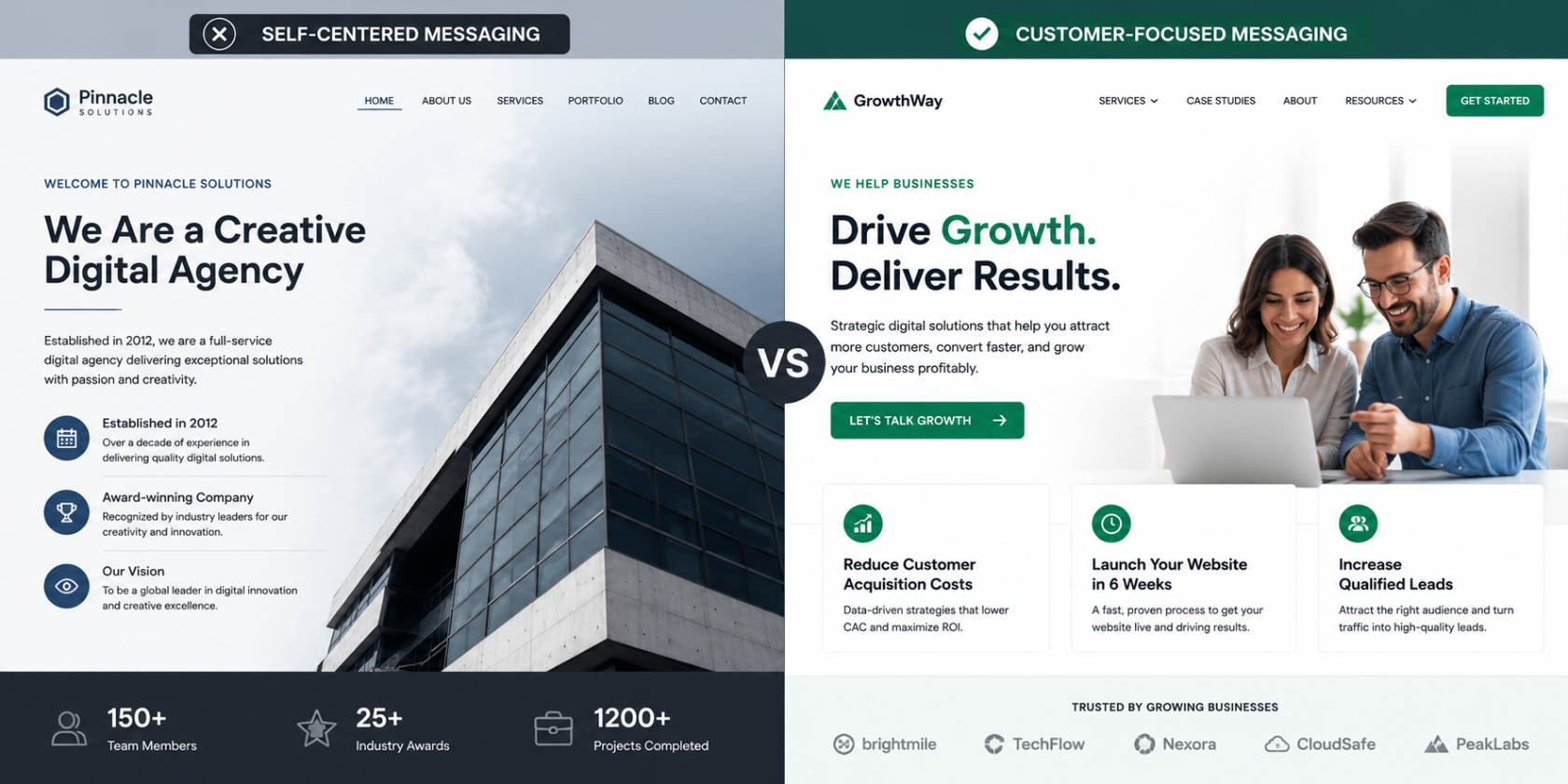
People don't buy because your business has been operating for ten years. They buy because they believe you'll make their business better, faster or more profitable. This is where many brand identity systems fail. The visuals may be polished, but the messaging is inward-looking. The identity celebrates the business instead of reassuring the buyer. A customer visiting your website doesn't need your entire company story before deciding whether to stay. They need immediate clarity on three questions: What do you do? Who do you help? Why should they trust you? If those answers aren't obvious within the first few seconds, visitors begin searching for them elsewhere. Some leave. Others compare you with competitors who communicate value more clearly. The strongest brand identities don't start with the company's achievements. They start with the customer's ambitions. Every visual element, headline, colour choice and supporting message should reinforce one commercial outcome: reducing uncertainty.
| Action | Do | Don't |
|---|---|---|
| Homepage messaging | Lead with the customer's problem and desired outcome | Lead with your company's history or mission statement |
| Brand storytelling | Position your business as the guide that helps customers succeed | Make your company the hero of every story |
| Value proposition | Clearly explain the commercial benefit you deliver | Use vague statements like "Innovation", "Excellence" or "Quality" without context |
Your Brand Hasn't Evolved With Your Business
Your business has grown. Your brand hasn't. It's a surprisingly common problem. Over the years, you've added new services, expanded into new markets, hired experienced people and delivered bigger projects. Your business today is far more capable than it was when you first launched. But your brand identity still tells the story of the company you used to be.
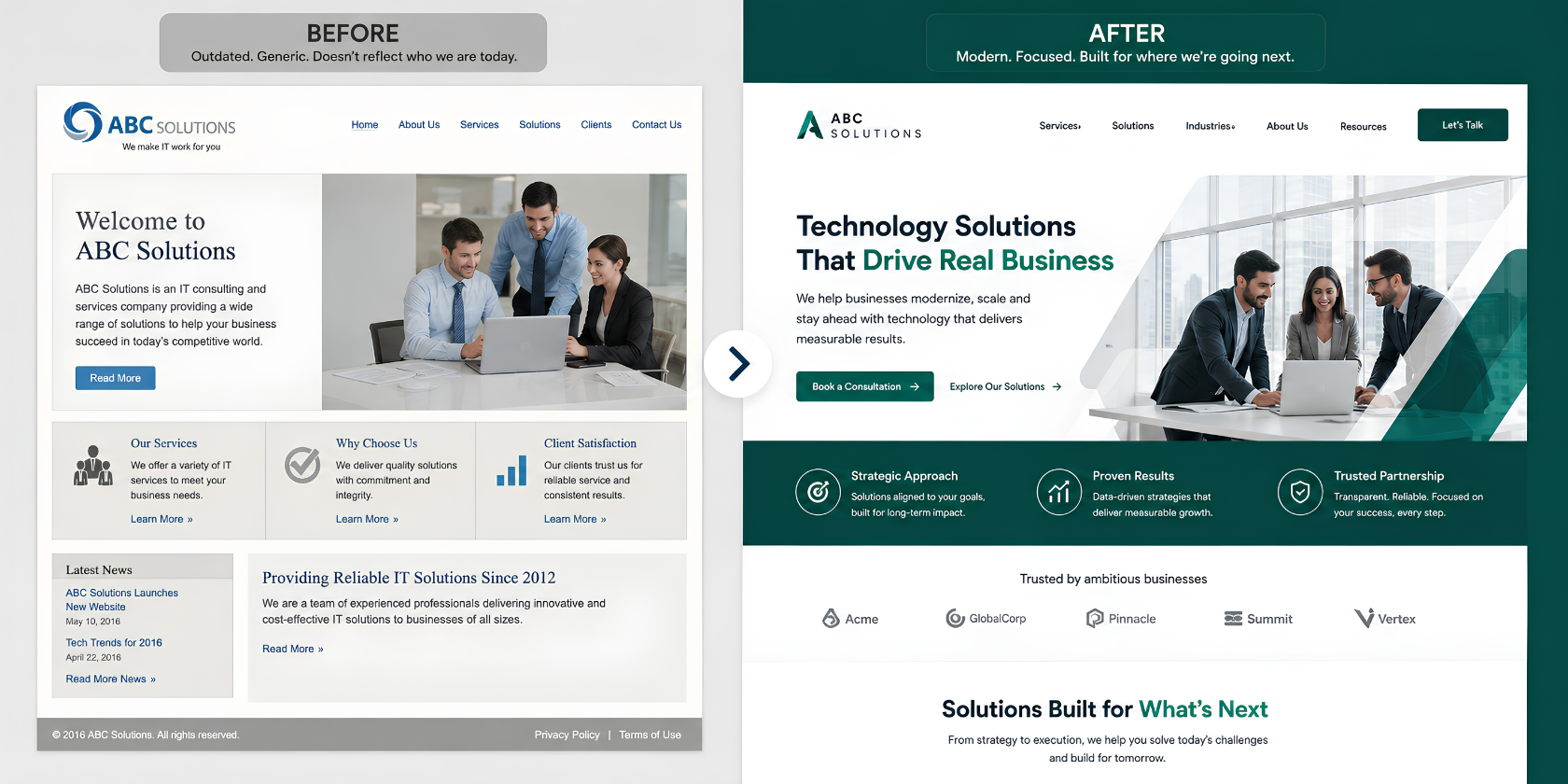
A prospect's first impression is shaped long before they speak to your team. If your website looks dated, your visual identity feels inconsistent or your messaging no longer reflects your expertise, they naturally assume your business hasn't evolved either. The disconnect is costly. A company delivering enterprise-level work with startup branding struggles to command premium pricing. A consultancy with years of experience but an outdated website appears less credible than a newer competitor with a stronger identity. Even referrals, who already trust the recommendation, often visit your website before making contact. If what they see doesn't match what they've heard, uncertainty creeps in. Brand identity isn't about looking trendy. It's about accurately representing the business you've become. An identity refresh isn't always about changing the logo. More often, it's about refining the entire experience—your messaging, visual system, website, photography, typography and tone of voice—so they reflect your current capabilities and future ambitions. When your brand grows with your business, customers see the value you've built before your sales team has to explain it.
| Action | Do | Don't |
|---|---|---|
| Brand reviews | Review your brand identity every few years as your business evolves | Assume the branding created at launch will always represent your business |
| Positioning | Update your messaging to reflect your current expertise and ideal customers | Continue describing your business the same way despite new services or markets |
| Visual identity | Refresh your website, imagery and brand assets to match your growth | Let outdated visuals create the impression that your business hasn't progressed |
Your Brand Identity Stops at Design Instead of Driving Decisions
Many businesses think brand identity ends when the designer hands over the logo files. In reality, that's where it should begin. A strong brand identity design isn't just a visual system. It's a decision-making system. It influences how your business communicates, how your sales team presents proposals, how your website is structured, what your advertisements say and even how you price your services. When identity exists only in design files, every department starts making its own decisions. Marketing launches campaigns that don't reflect the brand. Sales presentations use different messaging. Social media adopts trends that don't fit the business. Over time, the customer experiences several versions of the same company instead of one cohesive brand.
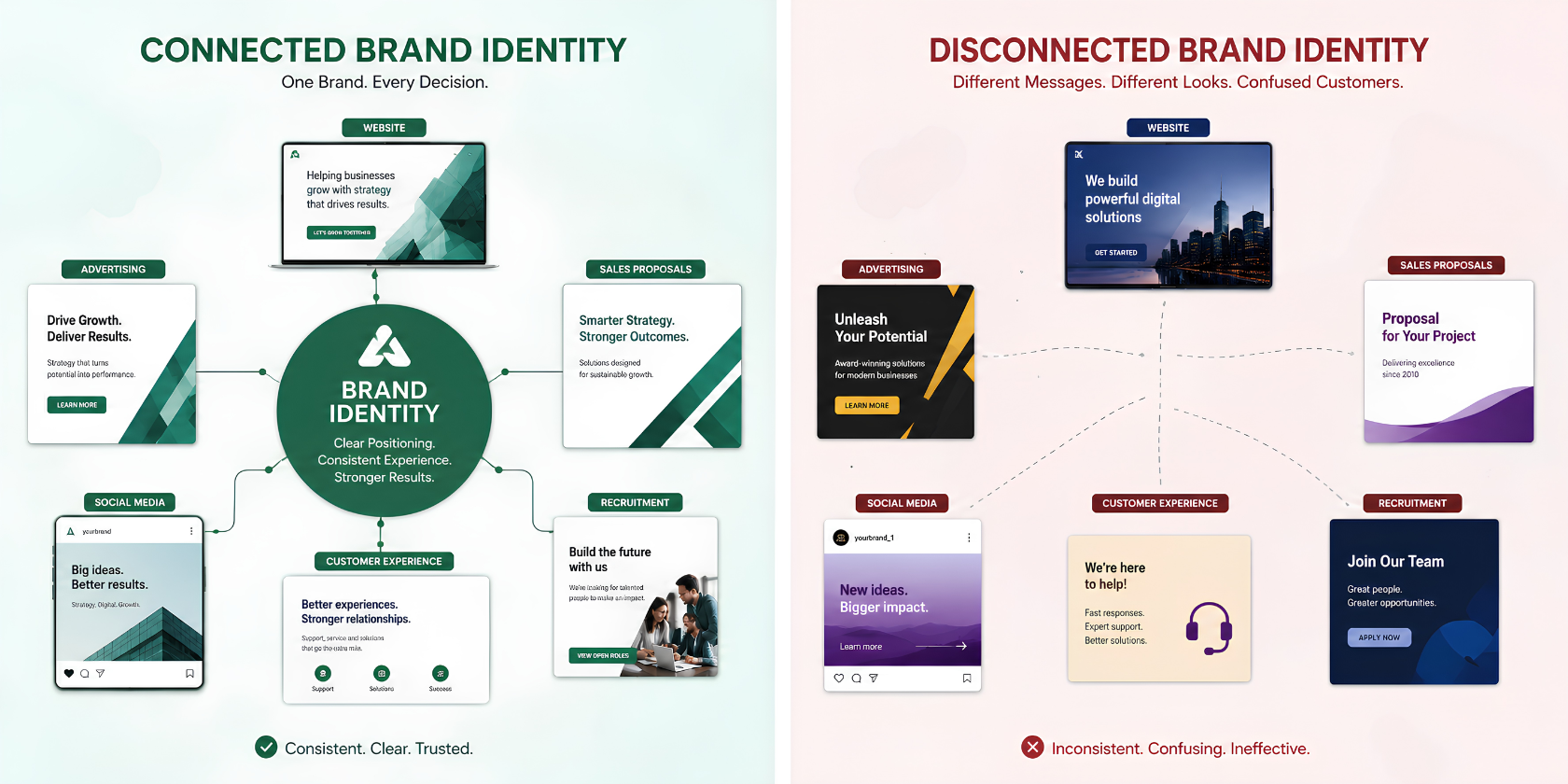
This inconsistency doesn't just confuse customers. It weakens every commercial decision your business makes. Imagine two companies offering the same service. One has a clear positioning, consistent messaging and a unified customer experience across every touchpoint. The other has good designers but no clear brand system. Their website says one thing, their ads promise another and their proposals tell a different story. Which one would you trust with a larger investment? Brand identity should answer questions long before a campaign goes live: Does this message sound like our brand? Does this design reinforce our positioning? Does this campaign attract the customers we actually want? Does this proposal reflect the experience we're promising? When every decision passes through the same brand system, marketing becomes more consistent, sales become more convincing and customers know exactly what to expect. That's when brand identity becomes a commercial asset—not just a creative one.
| Action | Do | Don't |
|---|---|---|
| Brand governance | Create clear guidelines for messaging, visuals and customer experience | Limit brand guidelines to logos, fonts and colour codes |
| Marketing decisions | Use your brand positioning to shape every campaign and piece of content | Allow every campaign to follow the latest trend without considering brand fit |
| Business alignment | Ensure marketing, sales and customer experience communicate one consistent promise | Let each team create its own version of the brand |
Brand Identity Tactics at a Glance
| Friction Point | Effort Required | Time to Impact | Best For |
|---|---|---|---|
| Build a consistent brand identity across every customer touchpoint | Low to Medium | Immediate to 4 weeks | Businesses with inconsistent branding across their website, social media, sales materials and ads |
| Shift messaging from company-focused to customer-focused | Low | Immediate | Businesses getting traffic but struggling to convert visitors into qualified leads |
| Refresh your brand identity to reflect your current business | Medium | 4 to 8 weeks | Companies that have expanded services, entered new markets or moved upmarket without updating their brand |
| Turn brand identity into a company-wide decision framework | Medium | Ongoing | Growing businesses where marketing, sales and customer experience feel disconnected |
What to Do This Week
Before investing in another marketing campaign or planning a rebrand, spend 30 minutes auditing your brand through the eyes of a first-time customer. Visit your website, LinkedIn page, Instagram profile and your latest sales proposal. Ask yourself four simple questions: Does every touchpoint look and feel like the same brand? Is the first message about my customer or about my company? Does my identity reflect the business we are today, or the business we were a few years ago? Is our brand guiding how we market, sell and communicate, or is it only visible in our logo and colour palette? Next, ask three people who don't work in your business to spend five minutes reviewing your website. Then ask them: What does this company do? Who is it for? Would you trust them with your business? Why or why not? Their answers will reveal gaps that internal teams often overlook. Finally, list every customer touchpoint—from advertisements and social media to proposals, emails and your website. If each one feels like it belongs to a different company, your marketing isn't starting from the same foundation. The businesses that consistently generate better-quality leads aren't always running better ads. They're making it easier for customers to trust them before the first click. A strong brand identity design doesn't just make your business look professional, it reduces friction, strengthens credibility and gives every marketing effort a better chance of succeeding.
About XCCELER
XCCELER is a growth acceleration and brand strategy firm that helps businesses turn their brand into a measurable commercial advantage. We combine strategy, brand identity design, websites, SEO, performance marketing and conversion optimization to build systems that don't just attract attention they generate qualified leads and drive sustainable growth.
Learn how XCCELER helps businesses build brands that convert