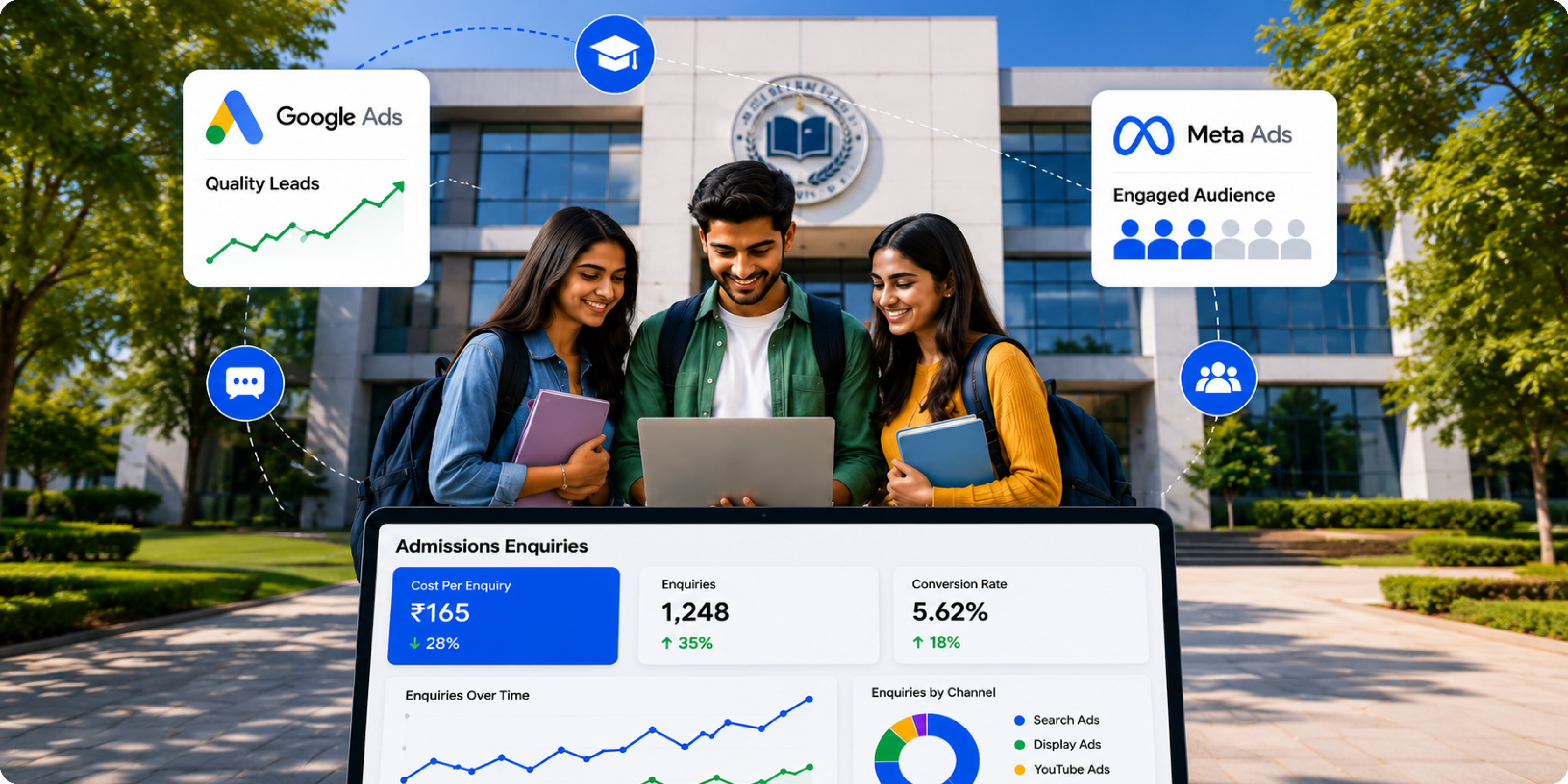
PPC for Education: How Schools and Colleges Can Reduce Cost Per Admissions Enquiry

Most schools and colleges running PPC campaigns are spending more per admissions enquiry than they need to, and the problem is not the platform. It's that they are running education PPC like a generic lead generation campaign and wondering why the results feel generic.
Here is what usually happens: You set up a Google Ads campaign targeting terms like "private school" or "college courses near me," watch the clicks come in at several pounds or dollars each, then realise that enquiries are not arriving at anywhere near the rate the click volume suggests they should. The budget runs out. Admissions targets do not. And the conclusion drawn by most senior leadership teams is that PPC does not work for education, rather than that this particular approach to PPC does not work.
The good news is that education is actually one of the highest-converting sectors in Google Ads in 2026, with a 13.14% conversion rate, the third highest of any industry tracked (WordStream, 2026). The problem is almost never the channel. It is the strategy.
Boost Your Business
The good news is that education is actually one of the highest-converting sectors in Google Ads in 2026, with a 13.14% conversion rate, the third highest of any industry tracked (WordStream, 2026). The problem is almost never the channel. It is the strategy.
What Is PPC for Education, and Why Does It Work Differently?
Consider this scenario. A parent is sitting at their kitchen table on a Sunday evening, searching "best secondary school in [city]" on their phone. A prospective postgraduate student is comparing programme fees on their laptop at 11pm. A working professional is looking for evening MBA courses during their commute. All three are searching with genuine intent. None of them are browsing. All of them are in a decision window.
PPC for education places your institution in front of these people at the exact moment they are looking. You pay only when someone clicks your ad. Unlike traditional advertising, which reaches people whether or not they are interested, education PPC connects you with prospective students or parents who have already identified a need and are actively researching solutions.
What makes education PPC different from other sectors is the buying cycle. An admissions enquiry is not a purchase decision. It is the beginning of a relationship that may take weeks or months to convert. Your PPC strategy needs to account for that complexity at every stage, from the first click to the submitted application.
How to Attract the Right Enquiries Without Wasting Budget on the Wrong Clicks
Here is where most institutions stumble: they optimise for click volume rather than enquiry quality. A high click count with a low conversion rate is not a performance problem. It is a targeting problem.
The correct approach is to build your keyword strategy around the language prospective students and parents actually use, not the language your admissions team uses internally. Parents search for "good schools with small class sizes near me." They do not search for "high attainment educational institutions with low pupil-teacher ratios." Someone looking for an evening MBA searches "part-time MBA London" not "executive postgraduate business management programme."
Aligning your keyword strategy with natural search language, layering in intent signals like "near me," "fees," "open day," and "apply," and matching each ad group tightly to its corresponding landing page is what separates campaigns that generate qualified enquiries from campaigns that generate impressive-looking click reports and disappointing admissions outcomes.
Your ad copy should read like a direct answer to the searcher's concern, not a brochure headline. "Rated Outstanding by Ofsted. Open Days Every Saturday" outperforms "Excellence in Education Since 1987" every time.
What Are the Best PPC Channels for Schools and Colleges?
Choosing the right channel mix for education PPC depends on where your prospective students are in the decision journey and which audience segment you are targeting.
Google Search: The High-Intent Channel
Google Search captures prospective students and parents at the moment of active research. With education sector conversion rates reaching 13.14% in 2026 (WordStream, 2026), search intent is the strongest signal available in education PPC. This is the channel for capturing demand that already exists.
Meta Ads: The Awareness and Retargeting Layer
Meta Ads (Facebook and Instagram) work differently in education. They are not primarily a direct response channel. They are where you build awareness with cold audiences who match your ideal student profile, and where you retarget warm audiences who have visited your website or engaged with your content. Education CTR on Meta ranges from 1.66% to 2.01% depending on season, peaking in January with New Year enrolment intent (Foundry CRO, 2026).
Display and YouTube: The Consideration Channel
Display and YouTube advertising builds familiarity and trust during the research phase. A prospective student who sees your campus video on YouTube, then finds your Search ad a week later, converts at a meaningfully higher rate than cold search traffic alone. These channels are not designed to convert directly; they are designed to make your Search ads work harder.
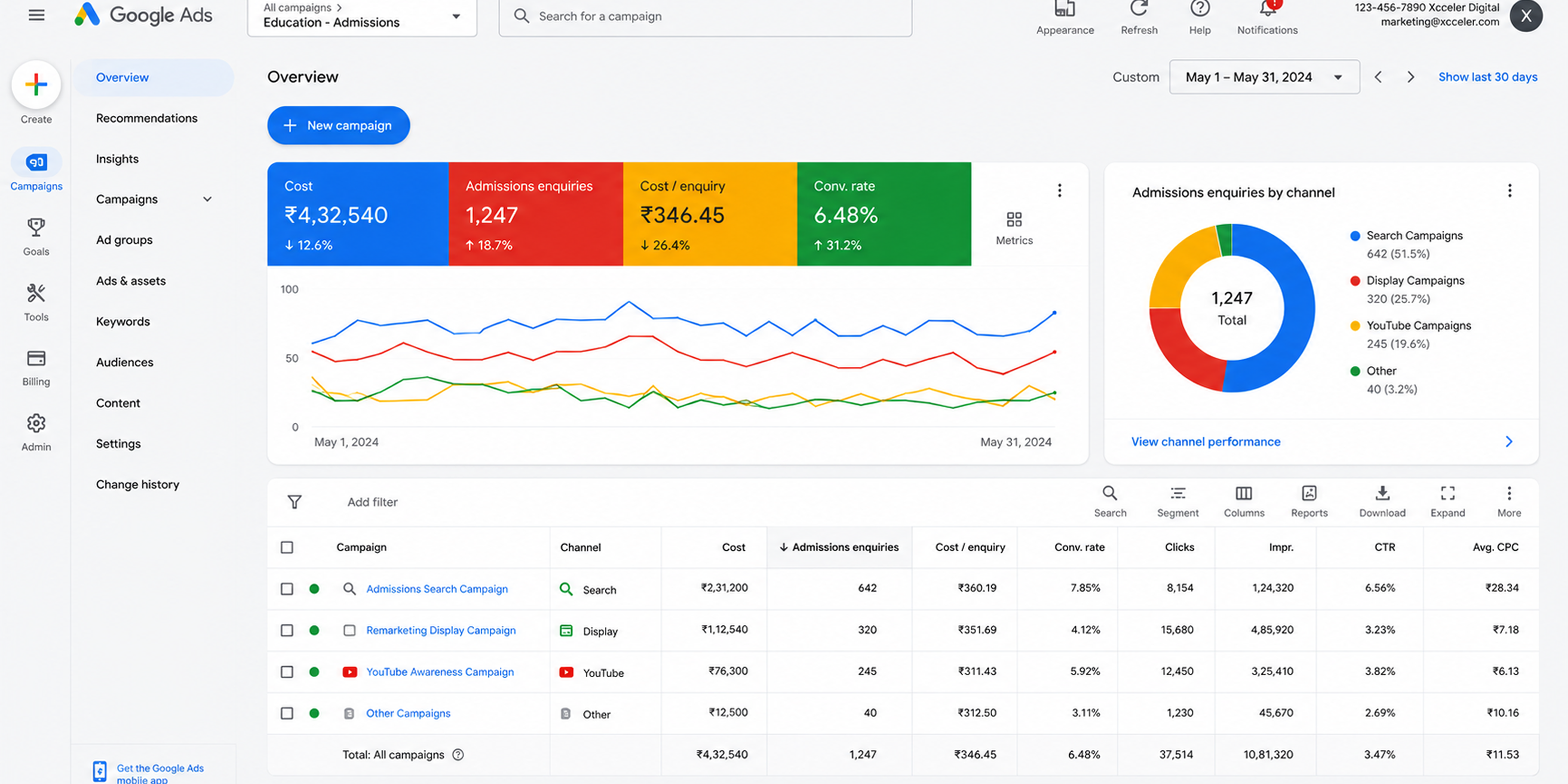
Pros & Cons of PPC for Education
Benefits of Education PPC
The case for PPC in education is strong when the strategy is right.
- Immediate enrolment-season visibility: Unlike SEO, which takes months to build, PPC can position your institution at the top of search results within days of launch. For time-sensitive enrolment windows, this speed advantage is decisive.
- Precise audience targeting: Want to reach parents of primary school age children within a 10-mile radius of your campus? Or working professionals aged 28 to 45 interested in postgraduate study? Education PPC enables this level of specificity at scale.
- Measurable cost per enquiry: Every click, form submission, and phone call is trackable. Unlike open days or print advertising, PPC gives you a direct line from spend to enquiry, allowing continuous optimisation.
- High conversion rate potential: Education and Instruction recorded a 13.14% average conversion rate in Google Ads in 2026, making it one of the highest-performing sectors when campaigns are well-structured (WordStream, 2026).
The Reality Check
- Above-average cost per click: Education is one of the most expensive sectors in Google Ads. Average CPC reached $6.23 in 2026, a 40% year-over-year increase (PPC Chief, 2026). Competitive keywords for popular programmes can exceed $10 to $15 per click.
- Long conversion cycles: An admissions enquiry rarely converts to an enrolled student in one session. PPC campaigns need to be structured for a multi-touch journey, not a single-click conversion.
- Seasonality creates budget pressure: Education PPC demand peaks sharply in January and July/August. Spreading budget evenly across the year means overpaying during low-intent periods and underfunding during high-intent ones.
Why XCCELER Knows How to Do This
As a growth acceleration and brand strategy firm, XCCELER has built PPC strategies for schools and colleges across competitive markets, and we understand the specific pressures of education sector advertising.
What you actually get:
- A team that understands the education buying cycle. Admissions enquiries are not e-commerce transactions. We build PPC strategies that account for the research phase, the comparison phase, and the decision phase, each with its own messaging, channel, and bid strategy.
- Keyword and audience strategy built around real search behaviour. We do not import generic keyword lists. We build education PPC campaigns around the actual language prospective students and parents use when they are genuinely ready to enquire.
How to Measure Education PPC Results
Track the metrics that connect directly to your admissions outcomes, not just platform performance.
- Cost Per Enquiry (CPE): The primary metric for education PPC. What does it cost to generate one admissions enquiry? Industry benchmarks suggest $68 to $122 per lead for education (PPC Chief, 2026). If you are significantly above this range, your targeting or landing page conversion rate needs attention.
- Enquiry-to-Application Rate: What percentage of PPC-generated enquiries submit an application? This reveals whether your PPC is attracting genuinely interested prospects or tyre-kickers.
- Click-Through Rate (CTR): Education sector benchmark is 3.95% to 6.64% on Search (CUFinder, 2026; WordStream, 2026). Below benchmark CTR usually signals an ad copy or keyword relevance problem.
- Conversion Rate by Campaign: Education averages 13.14% overall, but this varies significantly by programme, location, and audience (WordStream, 2026). If individual campaigns are running below 5%, investigate landing page match and keyword intent alignment.
If your cost per enquiry is above benchmark, the solution is almost never to increase budget. It is to improve targeting precision, landing page relevance, or ad copy alignment.
Guide to Education PPC Strategy
Align Your Campaigns to the Enrolment Calendar
Education PPC demand is not uniform across the year. January represents the peak enrolment research window, driven by New Year decision-making. July and August are critical for school-year transitions and September starts. Approximately 40% of your annual PPC budget should be concentrated in these peak windows (GrowthScribe, 2025). Running equal spend throughout the year means paying peak prices during January for inventory that was worth half as much in November.
Segment Campaigns by Programme and Intent
Running a single catch-all education PPC campaign is one of the most common and costly mistakes we see. A parent searching for a primary school place has completely different intent, decision timeline, and messaging requirements from a professional searching for an executive education programme. Separate campaigns by audience type, programme level, and intent stage. This gives you the control to optimise each segment independently and prevents your highest-value keywords from competing with your lowest-value ones for the same budget.
Build Landing Pages That Match the Ad, Not the Homepage
Sending PPC traffic to your institution's homepage is one of the most reliable ways to ensure your conversion rate stays low. A prospective student who clicks an ad for "evening MBA Manchester" and lands on a general university homepage has to do work to find what they came for. Most will not do that work. They will leave. Every ad group should connect to a dedicated landing page that answers the specific question the ad raised.
Use Negative Keywords to Protect Budget
A significant proportion of education PPC budget is routinely wasted on searches from current students looking for their institution's website, job seekers searching for education roles, and people researching topics rather than programmes. Negative keyword lists specific to education are not a one-time setup task. They require weekly review during enrolment peaks.
Read our guide on Paid Search Fundamentals for Education to understand how negative keywords can reduce wasted spend by 20% to 30% in the first 90 days of a campaign.
Education PPC Tips for Schools and Colleges
Target Audience Research Before Keyword Research
Understanding who you are trying to reach changes every subsequent decision. Parents of primary school children have different search behaviour, decision timelines, and trust signals from postgraduate students. Start with audience definition, then build keyword lists from the language each audience uses naturally.
Use Ad Extensions to Increase Visibility and Click Intent
Ad extensions significantly increase the amount of information visible in your ad without increasing cost per click. For education PPC:
- Call extensions allow prospective students to phone directly from the search result
- Sitelink extensions link directly to open day booking, fees information, and programme-specific pages
- Callout extensions highlight credentials: "Ofsted Outstanding," "Open Days Available," "UCAS Listed"
Geo-Targeting Matched to Your Realistic Catchment Area
Most schools and colleges have a defined geographic catchment within which the majority of their students travel. Running national or regional campaigns for a local institution wastes budget on enquiries you cannot convert. Target a radius that reflects your realistic draw area, and use bid adjustments to invest more heavily in postcodes with the highest historical enrolment rates.
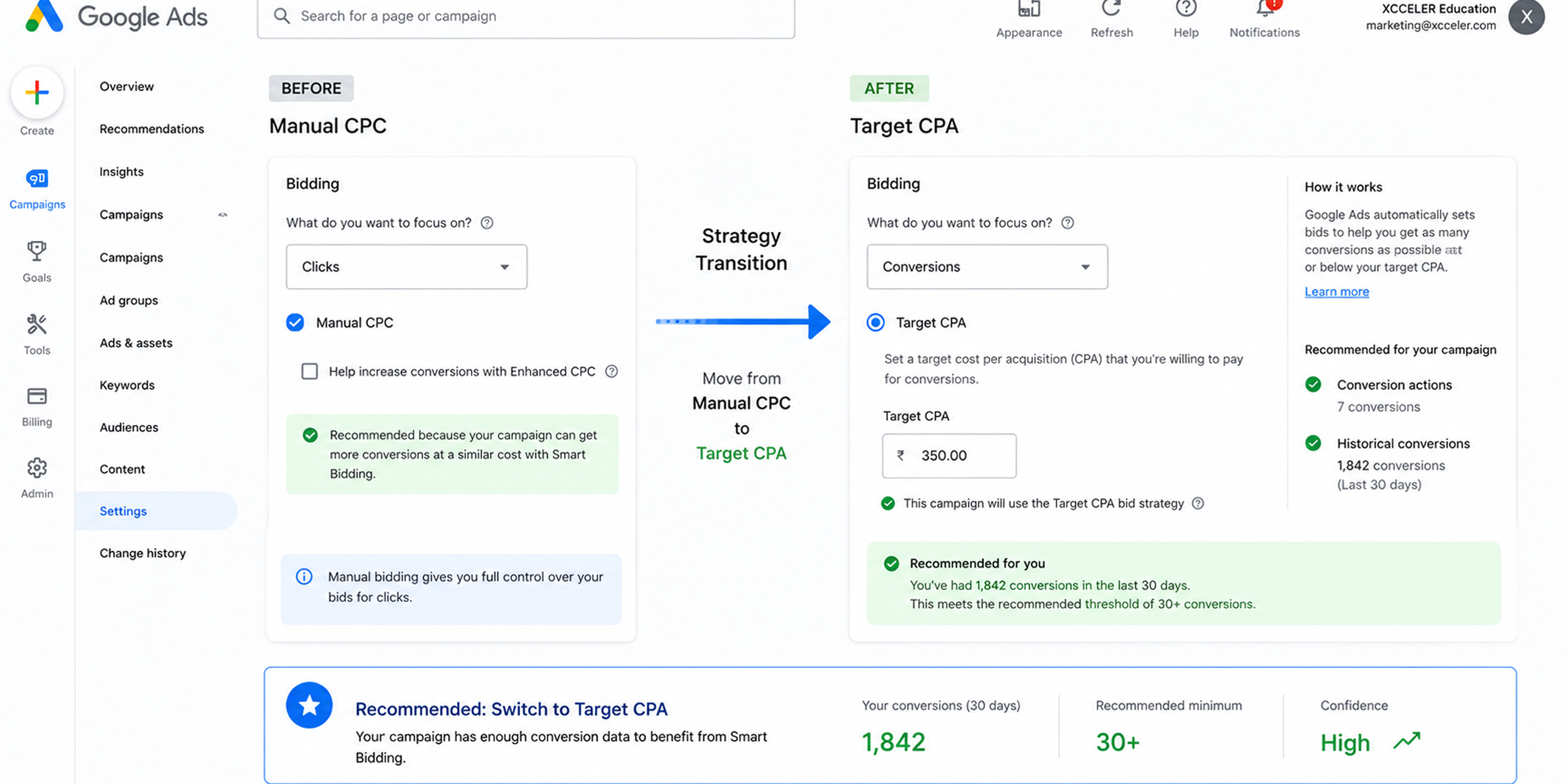
Bid Strategy Matched to Your Conversion Data
Start campaigns on manual CPC or Maximise Conversions while building conversion data. Move to Target CPA bidding once you have 30 or more enquiry conversions per month. Moving to automated bidding too early, before the system has sufficient data, is one of the most consistent causes of wasted spend in education PPC accounts.
Mobile Optimisation for the On-the-Go Researcher
More than half of education searches originate from mobile devices. If your landing page is not optimised for mobile, fast-loading, and easy to navigate on a small screen, you are paying for clicks that your landing page is converting back into bounces. Test every landing page on actual mobile devices before launching any campaign.
The Business Pain: Should Schools and Colleges Use PPC?
Education PPC is not difficult because the platforms are complex. It is difficult because education institutions face a specific set of structural pressures that generic PPC advice does not address.
The Seasonal Squeeze
Education demand is concentrated into short windows, but PPC budgets are often allocated annually and spent evenly. The result is that institutions are underfunding their ads during January, when enquiry intent peaks sharply, and wasting budget during August and September, when the academic year has started and demand has collapsed. This structural misalignment inflates cost per enquiry by paying for clicks that cannot convert.
The Audience Complexity Problem
Schools and colleges are not marketing to one audience. They are simultaneously targeting parents of different-age children, prospective undergraduate students, working professionals considering postgraduate study, and international applicants with different search behaviour and different decision timelines. Running a single campaign for all of these audiences produces mediocre results for all of them.
The Attribution Gap
Many education institutions cannot track the journey from a PPC click to an enrolled student. They can see enquiries. They cannot connect those enquiries to enrolments. Without this attribution, it is impossible to know which campaigns are generating students and which are generating enquiries that go nowhere. Budget allocation decisions made without this data are made on incomplete information.
Struggling With Any of These?
Common blockers we see across education institutions at this stage:
- Budget misallocation across the enrolment calendar: Spend concentrated in the wrong months, missing peak intent windows
- Undifferentiated campaigns across audience types: One campaign trying to reach parents, undergraduates, and postgraduate students simultaneously
- No tracking from enquiry to enrolment: PPC performance measured at the enquiry level with no visibility of downstream conversion
- Landing pages disconnected from ad intent: High click volume, low conversion, because the page does not match what the ad promised
This is exactly where XCCELER comes in. As a growth acceleration and brand strategy firm, we have built paid media strategies for education institutions navigating exactly these pressures.
Our education PPC services include:
- Campaign strategy and structure for schools, colleges, and universities
- Keyword research and audience segmentation specific to education enrolment cycles
- Landing page strategy and conversion rate optimisation
- Conversion tracking from PPC click to admissions enquiry
- Ongoing optimisation and monthly performance reporting
Education PPC: Why Generic Approaches Consistently Underperform
The 'More Budget Solves It' Assumption
The most common response to underperforming education PPC is to increase budget. This almost never works. If your cost per enquiry is high, adding budget accelerates the rate at which you generate expensive enquiries. The problem is structural, not budgetary. Fixing targeting precision, keyword intent alignment, and landing page conversion rate delivers more enquiries for the same spend. Adding budget to an unoptimised campaign delivers more wasted clicks.
The Keyword Volume Trap
Bidding on high-volume generic education keywords ("school," "college," "university," "courses") generates clicks from researchers, competitors, job seekers, and existing students looking for their institution's website. None of these are admissions enquiries. The clicks look impressive in a weekly report. The conversion rate tells a different story. High-intent, lower-volume keywords consistently outperform high-volume generic terms in education PPC because the searcher is further into the decision process.
The Homepage Landing Page Problem
Sending all PPC traffic to an institution's homepage or general admissions page is one of the most reliable ways to inflate cost per enquiry. A specific search requires a specific answer. Generic landing pages force visitors to navigate to find the information that should have been waiting for them when they arrived.
Education PPC Management: Strategic Solution Framework
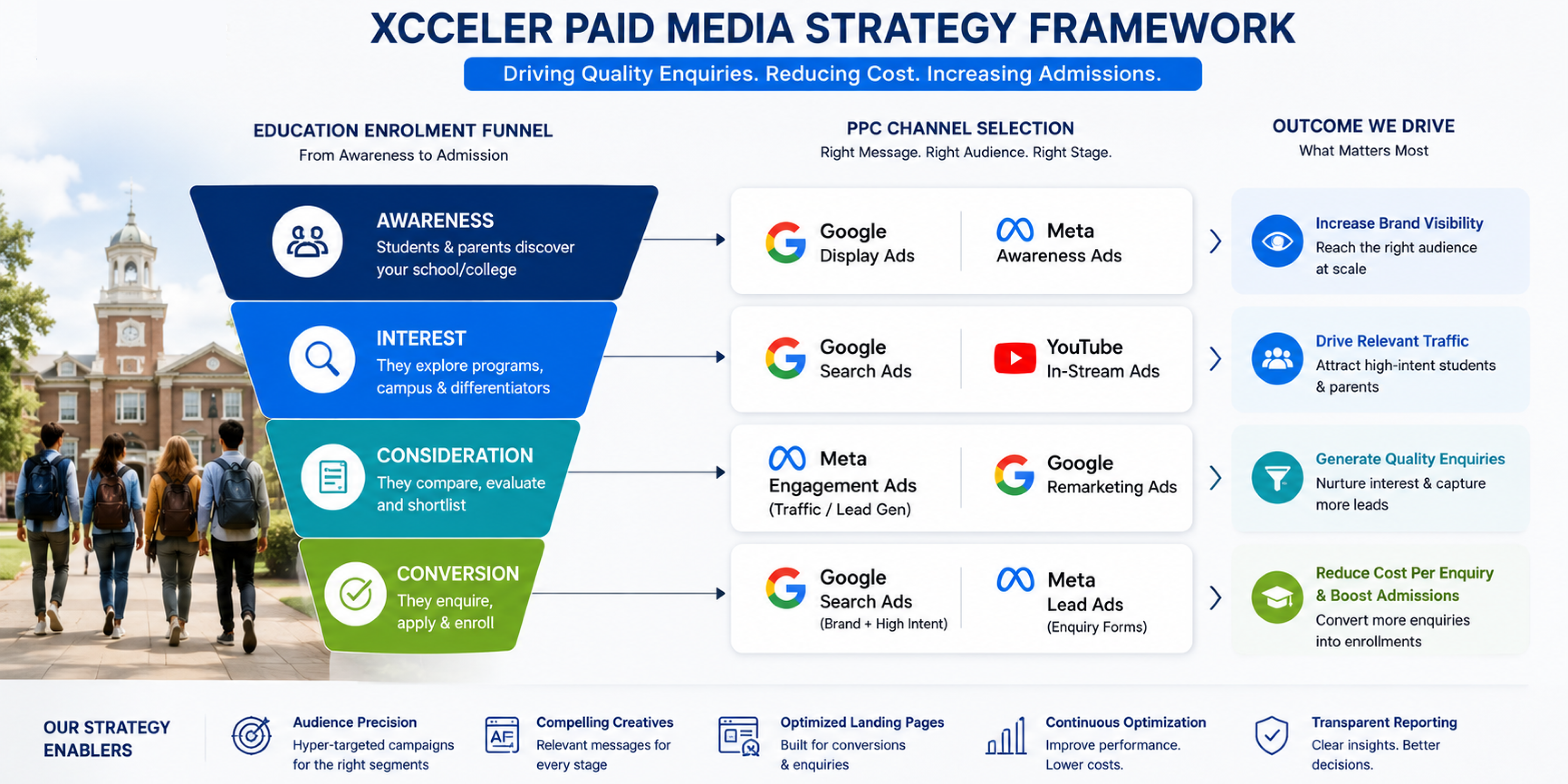
Build the Campaign Structure Around the Enrolment Funnel
The most effective education PPC accounts are not organised by programme or by department. They are organised by stage in the enrolment decision: awareness campaigns for cold audiences unfamiliar with the institution, consideration campaigns for prospective students actively comparing options, and conversion campaigns for high-intent searchers ready to enquire. Each stage needs different messaging, different landing pages, and different success metrics.
Integrate PPC With Your Broader Digital Presence
PPC works harder when it is not operating alone. Prospective students who have encountered your institution through organic search, email, or social media before clicking a PPC ad convert at higher rates and at lower cost per enquiry than cold PPC traffic. A prospective student who sees your Google Display ad, reads your blog, then clicks a Search ad when they are ready to enquire is significantly more likely to complete the application process than one who arrived through paid search alone.
Implement Full-Funnel Conversion Tracking
The most important infrastructure decision in education PPC is setting up tracking that connects a PPC click to a submitted enquiry to an interview booking to an enrolled student. Without this chain of attribution, you are optimising for clicks or form submissions without knowing whether those actions are producing enrolments. Schools and colleges that have this attribution in place consistently outperform those that do not, because every budget decision is informed by actual enrolment data.
Education PPC Strategies That Actually Work
Concentrate Budget in January and July/August
Education enquiry intent peaks sharply in January, driven by New Year enrolment decisions, and again in July and August ahead of academic year transitions. Allocating roughly 40% of your annual PPC budget across these two windows, while reducing spend in the low-intent months of March, April, and October, delivers significantly more enquiries per pound or dollar spent without increasing total budget (GrowthScribe, 2025).
Target Medium-Tail Keywords Over Broad Generic Terms
The sweet spot for education PPC keywords is medium-tail: "independent secondary school South London," "part-time MBA evening classes Manchester," "nursing degree with placement year." These terms are specific enough to indicate genuine intent, competitive enough to have meaningful search volume, and precise enough that your ad and landing page can answer the query directly. They consistently deliver lower cost per enquiry than broad generic terms, even though the cost per click may appear similar.
Use Remarketing to Re-Engage Website Visitors
Prospective students rarely enquire on their first visit. They research, compare, and return. A structured remarketing campaign, serving tailored ads to people who have visited your programme pages, open day booking page, or fees information, recaptures high-intent prospects at a fraction of the cost of acquiring cold traffic. Education institutions that run remarketing alongside their Search campaigns consistently see lower blended cost per enquiry than those running Search alone.
Match Open Day Campaigns to Specific Dates
Open days are your highest-conversion event. A prospective student who attends an open day converts to an application at a dramatically higher rate than one who only ever visited the website. Running dedicated PPC campaigns to promote specific open day dates, with landing pages that include the date, location, and registration form, with a clear deadline, consistently outperforms general admissions campaigns in cost per qualified interaction.
Read our guide on Education Admissions Funnel Strategy to understand how PPC fits into a full-funnel approach from first search to enrolled student.
Education PPC is fundamentally about timing and specificity. The institutions that win are not those with the largest budgets. They are the ones that show up with the right message at the exact moment a family or student is ready to make a decision. A well-structured campaign does not just generate enquiries. It generates enquiries from people who are already halfway to enrolled.
Ready to Reduce Your Cost Per Admissions Enquiry?
Stop allocating budget to education PPC campaigns that are generating clicks without generating enrolments.
At XCCELER, we are a growth acceleration and brand strategy firm that builds PPC strategies for schools and colleges that connect paid investment directly to admissions outcomes. We combine channel strategy, keyword precision, and conversion tracking to deliver measurable reductions in cost per enquiry.
Our education clients have built paid media systems that produce enquiries they can trace directly to enrolled students.
About XCCELER
XCCELER is a growth acceleration and brand strategy firm that partners with organisations to design strategies and experiences that convert interest into revenue.
Learn how XCCELER approaches paid media strategy